Spiny Water Flea (Bythotrephes longimanus)
Species Information
The spiny water flea (SWF) is a free-swimming predatory crustacean, native to lakes of northern Europe and
Asia. This species was discovered in Lake Huron in 1984. It quickly spread through the Great Lakes, and within
a decade, had invaded hundreds of inland lakes in the Great Lakes region. SWF were discovered in Gile Flowage
(Iron County) in 2003 by researchers at the UW Center for Limnology. Soon after, additional populations were
discovered in Stormy Lake (Vilas County) in 2007 and the Madison chain of lakes (Mendota, Monona, Waubesa,
Kegonsa) in 2009.
The current spread of SWF in Wisconsin is cause for concern. SWF are a voracious predator upon native
zooplankton, and have caused dramatic declines in native zooplankton in Canadian lakes. The native zooplankton
play two key roles in lakes: they are food for small fish and they consume phytoplankton and thus help control
algal blooms. The long spine of SWF inhibits consumption by smaller fishes, highlighting their potential for
disrupting the food web.
Their impact on Wisconsin’s lakes is not yet well understood. Researchers at the UW Center for Limnology are
currently monitoring Stormy Lake and the Madison Lakes to understand their effects on water clarity, fishes,
native zooplankton, and lake food webs as a whole. The Madison Lakes are among the most well-studied lakes in
the world, and this unfortunate recent invasion does provide an opportunity to understand their impacts.
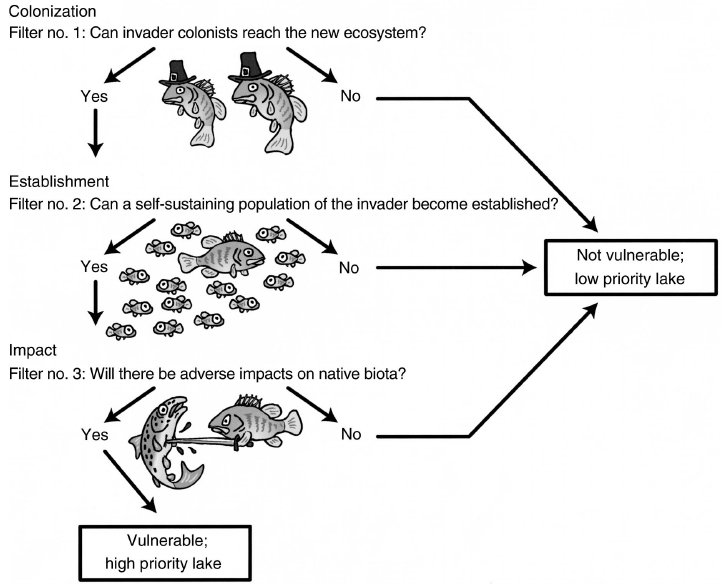
An urgent management challenge is to assess which lakes are vulnerable to spiny water flea invasion. One
study found that SWF tend to inhabit large, deep, clear lakes in their native range. Application of those
results to Wisconsin indicates that a large number of lakes are capable of supporting this invasive species.
Researchers at the UW Center for Limnology are currently developing statistical models that can be used to
identify which lakes are vulnerable to SWF (Papes et al. 2011).
Papes, M., et al. 2011. Invasive species research to meet the needs of resource management and planning.
Conservation Biology. 25 (5): 867-872.
Model Information
Assessment of lake suitability to spiny water flea based on modeled lake temperatures
Note: this project is a work in progress and the models presented here may be subject to changes as the
modeling improves.
The suitability analysis for spiny water flea (SWF) was carried out in 2018 by Jake Walsh in collaboration
with Jake Vander Zanden (UW-Madison), Jordan Read (USGS), and Gretchen Hansen (MNDNR/UMN-TC).
Background. Spiny water flea is a cool water zooplankter and is sensitive to warm summer surface
temperatures at the southern edge of its range, which includes Wisconsin (Kerfoot et al. 2011, Walsh et al.
2016). We used a 10,774-lake dataset of daily modeled lake temperature profiles from three time periods
(1981-2001, 2040-2060, and 2080-2100) in Minnesota, Michigan, and Wisconsin (Winslow et al. 2017) to estimate
lake thermal suitability to SWF under contemporary and future projected lake thermal conditions. Water
temperatures were modeled using seven different global climate models, six of which include projections under
future climate change scenarios (see Winslow et al. 2017 for details). Notably, all six GCMs are modeled under
the most extreme emissions scenarios (RCP 8.5).
MaxEnt model fitting. We modeled lake thermal suitability to SWF using a maximum entropy algorithm,
MaxEnt, a commonly used technique for modeling species distributions (Phillips et al. 2006), developing our
models using the package “maxnet” in R (Phillips 2017). The maxnet package fits environmental data to
occurrence data using lasso regularization of generalized linear models to generate the Maxent probability
distribution (Phillips 2017). Maxent is particularly useful for SDM modeling using presence only data
(essential here given just 40 confirmed occurrences and 10,744 background lakes) as well as estimating
non-linear effects of predictor variables (Phillips et al. 2006).
We selected three variables for model fitting: degree days above 20°C (SWF developmental rates plummet above
20°C; Lehman et al. 1997, Kim and Yan 2010), mean surface temperatures in October (°C; Bythotrephes
is most abundant in fall in our study region (Walsh et al. 2018); and log10 maximum observed lake depth (m;
since SWF is primarily pelagic, lake depth is the most likely morphological variable related to SWF habitat
variability in lakes; e.g., Young and Yan 2008). These variables are weakly correlated: cor(gdd_wtr_20c,
lake_depth) = -0.15, cor(gdd_wtr_20c, mean_surf_oct) = 0.51, cor(mean_surf_oct, lake_depth) = 0.63 (using
contemporary conditions under the GFDL GCM), but correlation among variables shouldn’t matter as much when
using Maxent relative to other niche modeling methods (Elith et al. 2011).
A key feature in MaxEnt modeling is the regularization multiplier, which essentially affects how tightly
fitted the model is to the occurrence data. If a model is too tightly fitted to the data, it risks being
ungeneralizable. Since we want to project our model into future lake temperature conditions, we increased the
default regularization multiplier, in effect “under-fitting” the model. We used a regularization multiplier
(“regmult”) of 2 (with the default being 1). Further, MaxEnt fits the models using multiple “feature classes”
to allow for nonlinear effects of environmental variables. We allowed the models to use all feature classes
(linear, quadratic, product, hinge, threshold), but note that with just 40 occurrences, the maxent algorithm
won’t use the product feature classes. However, the final models used nearly identical combinations of linear
and hinge features across all six GCMs (Fig. 1).
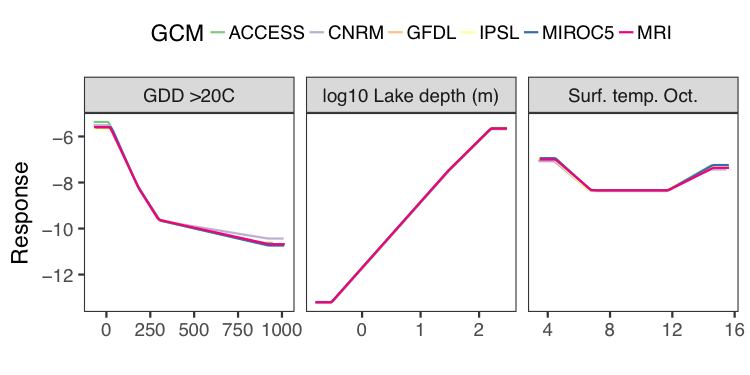
Fig. 1– Variable effects on raw maxent suitability output are plotted in colors that vary by
GCM.
Variable effects. We found that increasing GDD > 20°C had a negative effect on SWF suitability
while increasing lake depth had a positive effect on suitability (Fig. 1). Both of these findings are
consistent with our current understanding of SWF ecology. The effect of mean surface temperatures in October
on suitability was non-linear and U-shaped, possibly reflecting the positive effect of warming in a typically
cool season when SWF is most abundant (Fig. 1). Since temperatures in October aren’t expected to warm past SWF
thermal limits, any increases in temperature may increase developmental and population growth rates and may
offset the negative effects of warmer summer surface temperatures. It is worth noting that this trend toward
higher suitability at higher mean surface temperatures in October is driven by 11 of the 40 known occurrences
in the dataset and not by a small number of outlying occurrences. These lakes are warm in both summer and
fall, but tend to be deeper (e.g., > 9 m maximum observed depth).
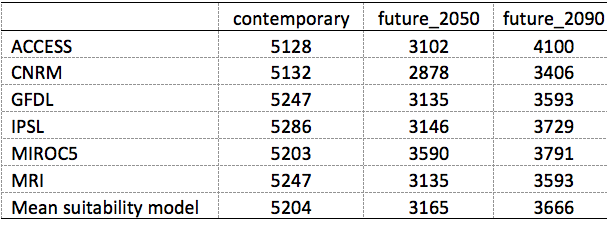
Results in entire study regionWe defined suitability as any lake with a suitability score as high as
the lowest score in a lake with confirmed SWF presence. Averaging suitability scores across all GCM-produced
MaxEnt models, we found that roughly half of the lakes in our study region (5,204 of 10,774 lakes) would be
suitable for SWF under contemporary conditions (Table 1). This fraction is expected to decline substantially
with future warming (3,666 suitable lakes in 2090), though we note interesting non-linear patterns between
2050 and 2090 scenarios (3,165 lakes in 2050), likely due to the interaction between suitability and mean
surface temperatures in October.
Table 1Model predictions (number of predicted presences where a presence is defined as a
suitability score at least as high as the score of the least suitable known occurrence) across each GCM and
time period. As a reminder: there are 10,774 total lakes in the dataset. Note: the mean is not the calculated
mean of the columns, but predictions from suitability scores averaged across all GCMs.
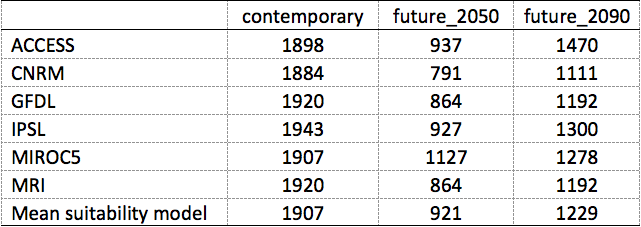
Results for Wisconsin. For the purposes of this online tool, we’re primarily interested in SWF
suitability Wisconsin. Of the 4,751 Wisconsin lakes in the dataset, 1,907 are predicted to be suitable under
contemporary conditions (40%), 921 are predicted to be suitable under 2050 conditions (19%), and 1,229 are
predicted to be suitable under 2090 conditions (26%) (Table 2).
Table 2 – Model predictions for Wisconsin (4,751 lakes in Wisconsin with SWF suitability
data).
Elith, J., S. J. Phillips, T. Hastie, M. Dudik, Y. E. Chee, and C. J. Yates. 2011. A statistical
explanation of MaxEnt for ecologists. Diversity and Distributions 17(1):43-57.
Kerfoot, W. C., F. Yousef, M. M. Hobmeier, R. P. Maki, S. T. Jarnagin, and J. H. Churchill. 2011.
Temperature, recreational fishing and diapause egg connections: dispersal of spiny water fleas (Bythotrephes
longimanus). Biological Invasions 13:2513–2531.
Kim, N., and N. D. Yan. 2010. Methods for rearing the invasive zooplankter Bythotrephes in the laboratory.
Limnology and Oceanography: Methods 8:552–561.
Lehman, J. T., D. M. Bilkovic, and C. Sullivan. 1997. Predicting development, metabolism and secondary
production for the invertebrate predator Bythotrephes. Freshwater Biology 38:343–352.
Phillips, S. J. 2017. maxnet: Fitting ‘Maxent’ species distribution models with ‘glmnet’. R package version
0.1.2. https://CRAN.R-project.org/package=maxnet
Phillips, S. J., R. P. Anderson, and R. E. Schapire. 2006. Maximum entropy modeling of species geographic
distributions. Ecological Modeling 190:231-259.
Walsh, J. R., S. E. Munoz, and M. J. Vander Zanden. 2016. Outbreak of an undetected invasive species
triggered by a climate anomaly. Ecosphere 7:10.1002/ecs2.1628.
Walsh, J. R., E. J. Pedersen, and M. J. Vander Zanden. 2018 Detecting species at low density: a general
theoretical framework and empirical test of the abundance-detectability relationship. Ecosphere 9(11):
e02475.
Winslow, L. A., G. J. A. Hansen, J. S. Read, and M. Notaro. 2017. Large-scale modeled contemporary and
future water temperature estimates for 10774 Midwestern U.S. Lakes. Scientific Data 4:170053.
Young, J. D., and N. D. Yan. 2008. Modification of the diel vertical migration of Bythotrephes longimanus
by the cold-water planktivore Coregonus artedi. Freshwater Biology 53(5):981-995.
Metadata for understanding shapefile output
Model threshold for suitability: ≥-10.1526; (this is the lowest raw suitability score for a lake with a known
SWF population)
Shapefile column names:
“lat” = latitude of the centroid of the lake shapefile
“long” = longitude of the centroid of the lake shapefile
“suitCont” = raw suitability score for the contemporary time period
“predCont” = binary suitability based on above threshold
“suit2050” = raw suitability score for the late century time period
“pred2050” = binary suitability based on above threshold
“suit2090” = raw suitability score for the late century time period
“pred2090” = binary suitability based on above threshold
“pa” = known SWF occurrences (1 = presence)
“RawSuit” = raw suitability score (redundant w/suitCont)